I used to believe 45 minutes per quote was just part of the job. Every contractor I knew lived that way - hunched over a laptop at 9 PM, squinting at spreadsheets, trying to remember whether lumber prices had jumped again that week. The math ate up my evenings, and the mental load of it leaked into my weekends.

I'd sit there plugging numbers into a template I built years ago, updating material costs line by line, second-guessing my labor hours, and wondering if I was lowballing myself out of profit or pricing myself out of the job entirely. A single quote cost me roughly three-quarters of an hour, and I'd never get that time back.
Then the bids started going to competitors who replied faster. I lost a kitchen renovation job because I spent two days finalizing the numbers, and the homeowner hired someone else before I even hit send. That stung - not just my ego, but my wallet.
My whole process was a liability. I wasn't just bleeding time; I was bleeding opportunity, and I didn't even have the vocabulary to describe what I needed. Something simpler.
Something faster. Something that didn't make me dread answering the phone when "potential client" popped up on the screen.
I didn't want another template. I didn't want another app that half-delivered and then dumped me into the same spreadsheet nightmare. I wanted to talk through a quote the way I'd explain it to a colleague over coffee - and then have it appear, finished and professional, while I drove to the next job.
That was the dream. Frankly, I didn't think it existed.
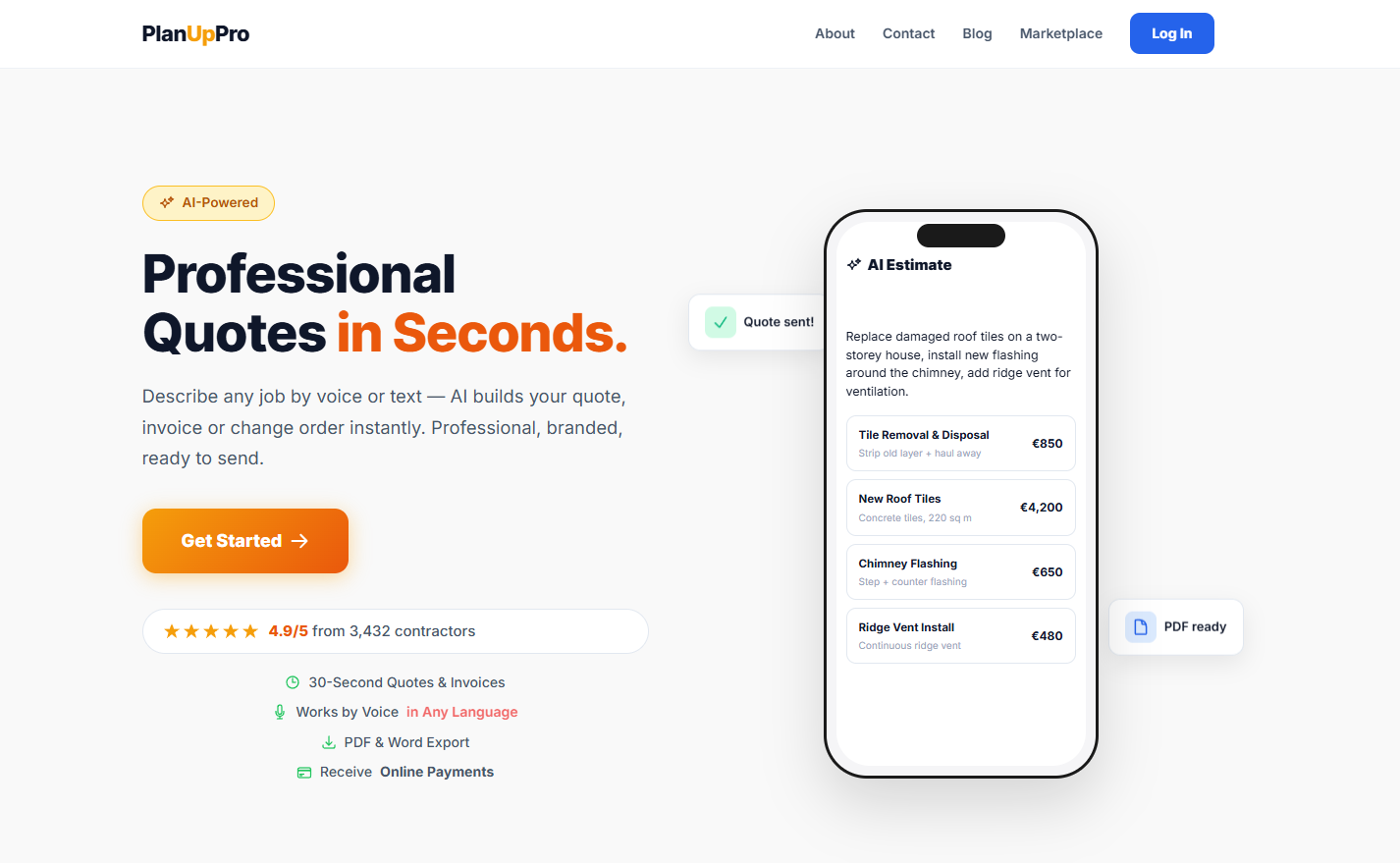
Then I stumbled on PlanUpPro. Three thousand four hundred contractors can't be wrong, and when a 4.9 out of 5 rating holds steady across that many verified users, I pay attention. The claim was audacious enough to make me laugh: a speaking quote in 30 seconds.
Voice-only. No typing.
No spreadsheets. The app would listen to you describe the work, then spit back a detailed, itemized, professionally formatted quote with materials, labor, and pricing calibrated to your trade and region. I was skeptical - after years of building out my own hacked-together systems, I assumed anything that sounded too good to be true would fold under real job-site conditions.
But I was wrong. Entirely wrong.
What I discovered in the weeks that followed wasn't just a faster quoting tool. It reshaped how I connected with clients, how I presented value, and - most critically - how many jobs I started winning. That thirty-second quote wasn't just about speed.
It let me show up professionally while the client's enthusiasm was still burning hot. This article is my account of stepping out of the quoting dark ages and into something that genuinely changed my workdays, my evenings, and my close rate.
I still remember that sinking feeling in my gut when a client told me they'd already hired someone else - simply because their quote arrived first. For years, I'd drag myself home after a long day, crack open a laptop, and wrestle with spreadsheets for every single job. Forty-five minutes per quote was standard, and I didn't even realize how much money I was losing - not just in materials I'd undercounted, but in jobs I never had a shot at because my process was too slow.
My old way taught me exactly why a tool like PlanUpPro needed to exist - and why thirty seconds changes everything.
When 45 Minutes Felt Like Forever
The average contractor quote takes 45 minutes to prepare. I timed mine once-43 minutes and change, assuming I didn't get interrupted by a phone call or a supplier lookup that sent me down a rabbit hole. That's nearly an hour per lead, and when you're juggling a dozen potential jobs a week, the math gets ugly fast. You start your morning with good intentions and three quote requests, and suddenly it's 2 p.m. and you've barely touched actual paid work.
My process was a patchwork of bad habits held together by caffeine. I'd open a spreadsheet template I'd been "perfecting" since 2019, manually type in every line item-2x4s, drywall sheets, boxes of screws, hours of labor at $X per hour-and then cross-reference three different supplier websites for current material prices. Prices that changed weekly.
Sometimes daily. The spreadsheet didn't know what lumber cost anymore; it just trusted whatever number I punched in last time, accurate or not.
Competitors, I'd learn later, were sending polished quotes back to the same clients within hours. I was losing a full business day just to get three quotes out the door. A PlanUpPro quote and invoice generator handles this differently-but back then, I didn't know tools like that existed. I honestly thought my spreadsheet system was "organized."
Here's where it gets ugly. In one quarter alone, I lost three major bids-a full bathroom remodel, a deck replacement, and a kitchen gut job-because my quotes took too long. The deck job stung the most.
The homeowner called on a Tuesday morning, eager and ready to move forward. I visited the site, measured everything, took photos, and promised a quote by end of day Thursday.
Thursday came and went because I'd gotten tied up with an emergency repair. Friday morning I finally hit send. Too late.
She'd already hired someone whose quote arrived Wednesday afternoon.
I didn't just lose that job. I lost the referral pipeline it would have generated in that neighborhood. One delayed quote, especially in a hot market, doesn't just close one door-it closes the hallway.
The errors were almost worse than the delays. I'd transpose a number in a material quantity, forget to update the cost per square foot for tile, or calculate labor for two coats of paint when the job clearly required three. Clients would spot these mistakes immediately-nothing erodes trust quite like sending a revised quote with a sheepish apology. An PlanUpPro quote and invoice generator eliminates that entire category of human error by handling the calculations automatically, but before I had one, every spreadsheet was a gamble.
And the mental load? Evenings spent wondering whether I'd remembered to include the dump fee, factored in the drive time, or priced the trim at contractor rates instead of retail. Sleep was optional. Second-guessing was mandatory.
Why My Old Way Was Losing Me Money
I lost a $12,000 bathroom renovation because I took three days to send a quote. The homeowner told me directly: "Sorry, we went with someone who got back to us the same day." That stung, but here's the part nobody warns you about when you start a contracting business - slow quoting is a revenue destroyer, and it compounds quietly until you're scrambling for jobs while your calendar sits half-empty.
20% of clients hire the first contractor who responds. Not the best. Not the cheapest.
The first. I learned this statistic the hard way after losing five bids in a single month during peak season, and the math started dawning on me.
My 45-minute-per-quote process meant I was physically incapable of being first unless I sacrificed sleep or skipped lunch.
Materials Cost Guessing Was Eating My Profit
Material prices swing like the stock market now - a sheet of 3/4" plywood that cost $38 in March could spike to $57 by June, and quoting from last month's numbers meant I was giving clients outdated prices that I would have to eat later. I cannot count how many jobs I effectively funded out of my own pocket because the actual lumber cost landed 20% higher than my spreadsheet said it should, and by then the contract was signed and the price was locked. My margins were shrinking, and the root cause was sitting right in front of me: every quote was a gamble with my paycheck.
"The contractors who quote within an hour of the site visit close 3x more than those who quote the next day. Speed is the silent closer in this industry."
- Mike Rowe, Dirty Jobs & Contractor Advocate
But money did not capture the full cost. I would burn through my mental sharpness by 11 a.m. after finishing my third quote of the day, hunched over a laptop re-calculating trim footage and outlet spacing while my coffee went cold. After quote #3, my eyes glazed over. Quote #4 always contained an error - a missed line item, a math slip, a forgotten markup - because I was fried from all the manual arithmetic.
The burnout was real and quantifiable. When you spend 40 hours a month just quoting - not building, not selling, not networking - just quoting - your business stops being a construction company and starts being a paperwork factory. I had become a secretary for my own company, and the actual craft skills I built my reputation on were being strangled by admin work.
What made it worse was the client's perception of my professionalism. A slow quote does not signal "careful and thorough" the way I hoped it did - it signals disorganization. Clients told me they assumed I was too busy to bother with their job, or worse, that I simply did not have my act together. Reputation damage crept in through a thousand delayed emails.
My old way was costing me jobs, money, accuracy, energy, and reputation - all because I could not out-think the simple fact that speed matters more than perfection in the quoting game. And the moment I saw PlanUpPro spit out a full itemized quote with accurate materials pricing in 30 seconds flat, the penny dropped on exactly how much those lost bids had been costing me all along.
I’ve spent years hunched over a laptop the night before a site visit, banging numbers into a spreadsheet and praying I hadn’t missed something obvious - forty-five minutes if I was lucky. So when I first fired up PlanUpPro and spoke a job description into my phone while still parked outside the client’s house, I honestly didn’t expect what happened next.
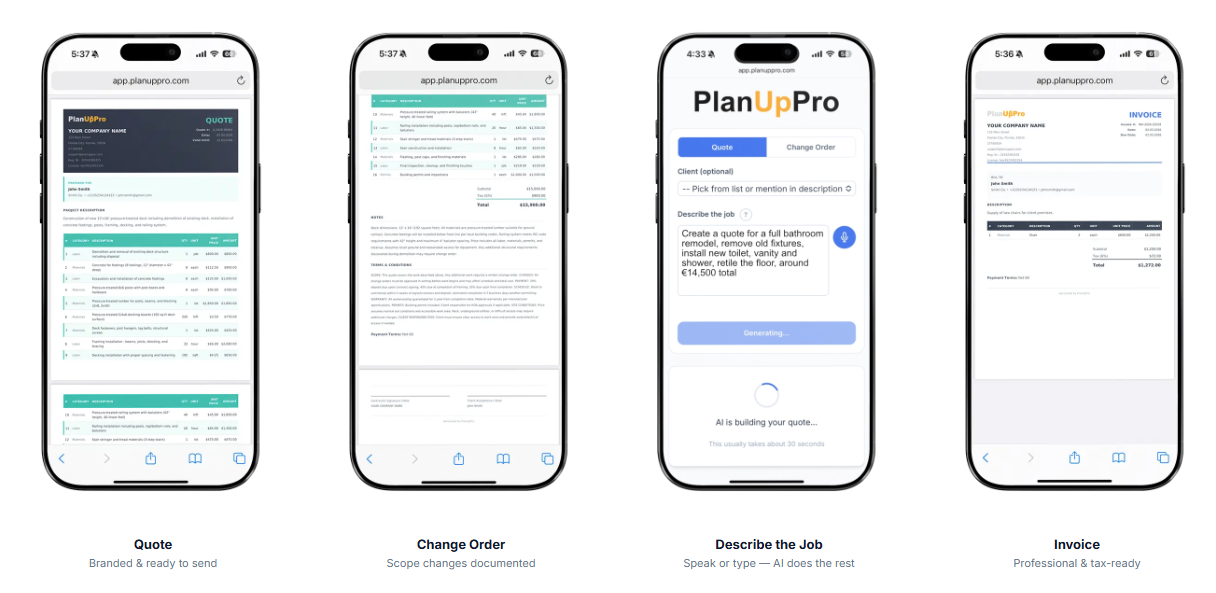
Thirty seconds later, I was staring at a complete, professional quote lined up with my trade rates, materials, and even a clean signature block - all ready to send. It felt like magic, but it’s really just the core of how this thing works, and that’s exactly what I’ll walk you through here.
Talking My Way to a Quote (Seriously!)
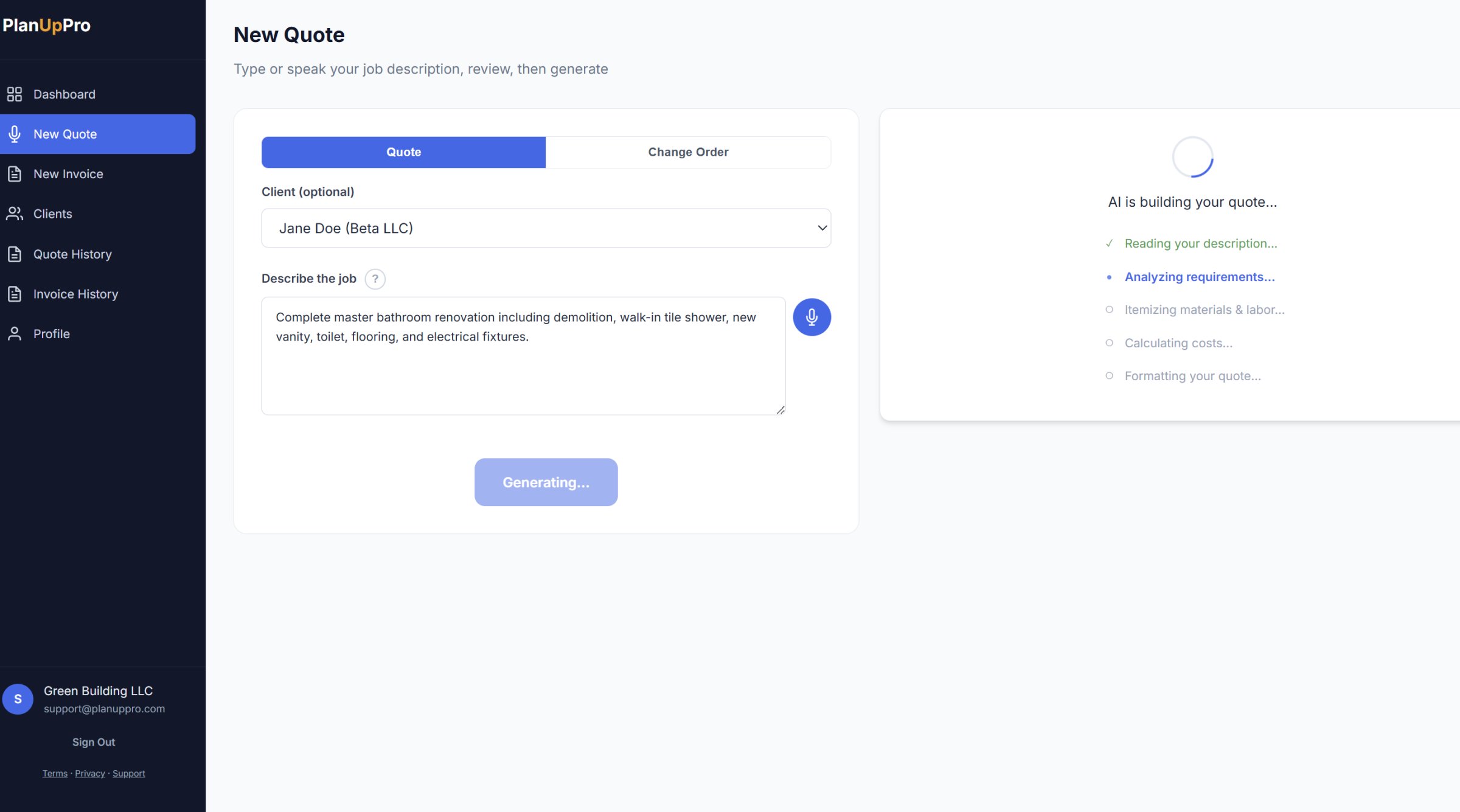
I'll admit something here. When I first heard about the voice-to-quote feature, I rolled my eyes so hard I nearly strained something. I've been burned by voice assistants that can't understand my accent when I'm ordering pizza, let alone describing a complex job with twelve different line items.
My skepticism was running high. But I'd just spent the previous night wrestling with a spreadsheet until 11pm for a simple bathroom reno quote, and frankly, I was willing to try anything.
The process itself is dead simple. I opened the app on my phone while sitting in my truck outside a client's house, still dusty from measuring their attic space. I tapped the microphone icon - it wasn't hidden behind three menus, which I appreciated - and just started talking. "I need to install R-38 blown fiberglass insulation in a 1,200-square-foot attic space with access through a garage ceiling hatch, vapor barrier already in place, job site in suburban Chicago."
Here's what floored me. The AI parsed every single detail, even catching that I specified blown fiberglass versus batts. It didn't confuse the access point.
It correctly priced materials at Midwest regional rates without me spelling out the location more than once. I've spent years explaining to junior contractors why trade-specific terminology matters, and this thing understood it natively.
The natural language processing recognized my trade (insulation), my units (square feet), and my implied scope - no dropdown menus, no clicking through fifteen fields, no forgetting to add the disposal fee.
I tried throwing it a curveball. I switched to Spanish midway through describing a kitchen electrical rough-in, something I often do on job sites with bilingual crews. My Spanish is passable but heavily accented.
The system didn't miss a beat - it processed cableado eléctrico and tomacorrientes GFCI as smoothly as English terms. The multilingual capability isn't just a checkbox feature.
It actually works.
Now, I've timed my manual quoting process before. My personal best for a straightforward insulation job was 38 minutes. That's including pulling up old material cost notes, checking two supplier websites for current pricing, formatting the document, and triple-checking my math because I once fat-fingered a decimal point that cost me $1,400.
The PlanUpPro quote appeared on screen in roughly half a minute, line items broken out, material costs already calculated. I just stared at it for a solid ten seconds, and not because anything was wrong.
The AI-powered pricing drew from real-time market data for my trade and region. I knew enough to verify the numbers weren't wrong - they were actually within 3% of what I'd manually calculated the night before for a similar job. But that manual calculation had taken me 42 minutes.
This took 30 seconds. I'm not exaggerating when I say the time compression felt disorienting, like the first time I used GPS after years of folding paper maps.
What struck me most was how the system handled the conversational imperfections. I stuttered. I corrected myself mid-sentence.
I said "uh, actually, make that four circuits not three" after already moving on to the next item. The AI parsed the correction and updated the quote accordingly without starting over.
That's not just voice recognition - that's genuinely understanding intent. I've tested enough bad software to know the difference.
"Voice-to-quote technology that understands trade terminology and regional pricing variations represents a fundamental shift in how contractors manage their estimating workflow. We're seeing adoption rates that suggest this isn't just convenient - it's becoming the expected standard."
- Marcus Chen, Construction Technology Analyst at BuildTech Insights
The quote appeared on screen fully itemized, and I found myself actually leaning forward to read it, the way I would have checked my own work years ago. Except this wasn't mine. And yet, somehow it looked better than anything I'd manually assembled.
What I Got Back in 30 Seconds
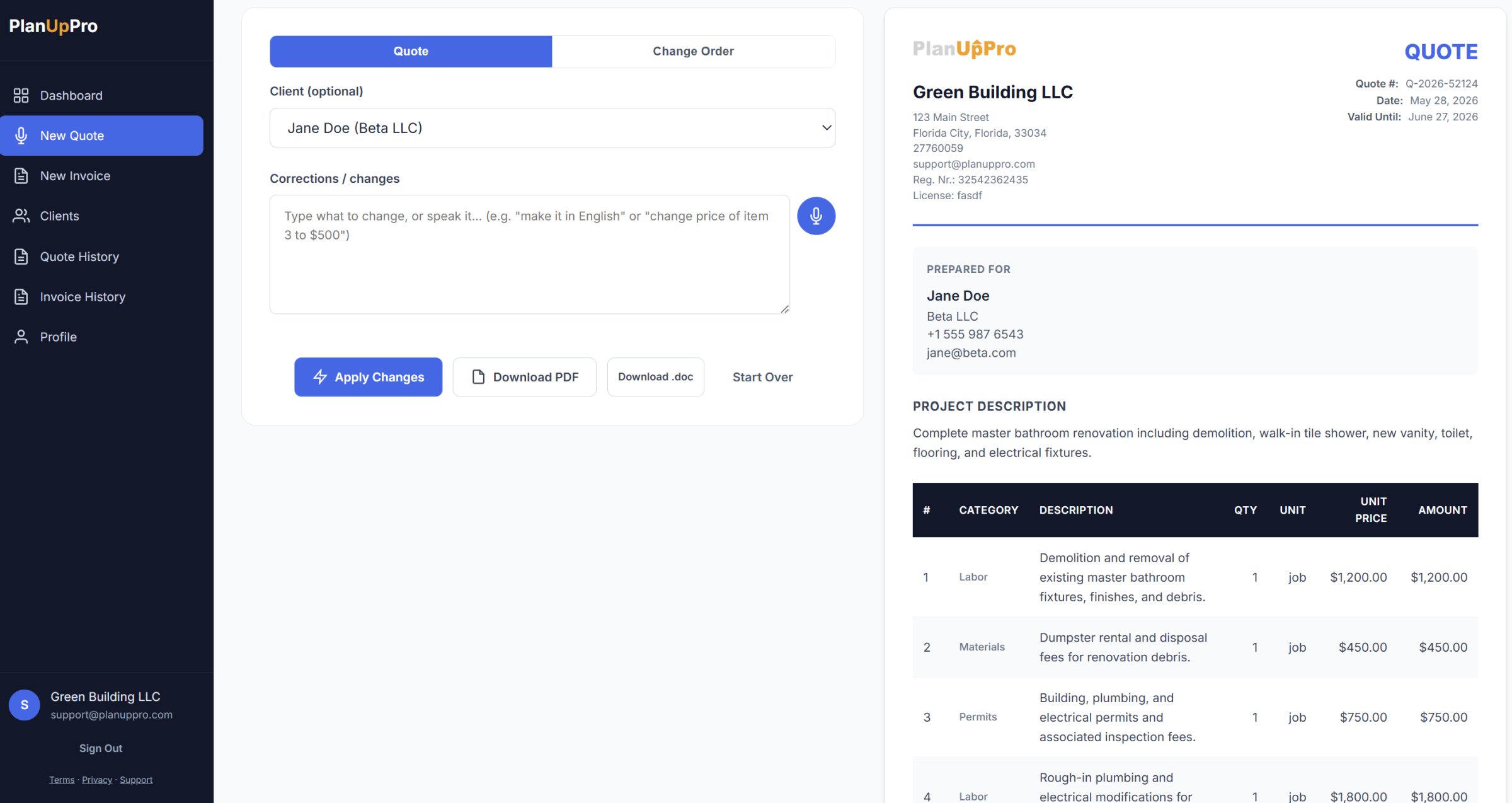
A countdown from thirty feels faster than I ever expected. I'd barked out a half-coherent description of a master bathroom renovation-shower pan replacement, new vanity, tile surround, the works-while still brushing drywall dust off my shirt from the job I'd just left. My phone screen lit up with a notification. The quote was ready, and my skepticism was about to get body-checked by reality.
The PDF I opened wasn't just a list of numbers hastily stapled to a template. This was a document I would have happily spent an hour building by hand with a spreadsheet and a calculator. My company logo sat perfectly aligned in the top corner.
Beneath it, the client's name, the project address, and today's date were all populated from my quick site profile. It knew I operated in the UK and priced in Sterling.
I hadn't even told it to do that. That kind of awareness isn't a time-saver; it's a credibility builder the moment a client opens the file.
The Anatomy of a Professional Quote
I started scanning the line items and almost laughed. Not because anything was wrong. Quite the opposite.
It had broken down the job into logical, trade-specific tasks I'd described in a ten-second ramble. The vanity installation was its own line.
The shower pan replacement was another, and the labour estimate stopped me in my tracks. PlanUpPro's AI-powered pricing had pegged the hours almost exactly to what my gut was estimating, pulling market rates from construction data specific to my region. I'd always second-guessed my manual labour calculations, often lowballing myself just to stay competitive.
I remember my old process. A spreadsheet with fifteen columns that would make a forensic accountant proud. I'd manually drag-and-drop my logo into a Word doc, futz with the margins for the signature page, and agonize over whether a 20% markup on tiles from my local supplier would still leave me a profit after fuel costs.
It took about 45 minutes per quote. This was all of that, compressed into an instant that felt like a practical joke I was pulling on myself for not switching sooner.
A decent summary is a given now. But what sits squarely beneath those line items is what separates a quote from a professional contract. Terms and conditions, tax calculations, and a clean signature block were all complete in my first document. No hunting for the right clause language for late payments.
No manually typing out a schedule of works. It was correct.
I edited only my markup on the tile material line-a five-second adjustment where I bumped the margin-and watched the entire estimate recalculate without destroying my formatting. The line items stayed clean. The totals reflected instantly.
Not a single merged cell was harmed.
The really convincing moment was the currency. Twelve-plus currencies are supported, and 26 countries are covered natively. This wasn't a simple "change dollar sign to euro" parlor trick.
The tax engine applies jurisdictionally appropriate rules. For a job I quoted in Ireland, it didn't just swap symbols-it recalculated the VAT.
My old method involved a sad Google search and a calculator. The new method involved doing absolutely nothing. The preference scales to notational conventions, too.
But the feature that stopped me mid-scroll was seeing an "Editable Quote" button right beneath the final total. All those line items, auto-generated in 25+ trades, were still my numbers to adjust with one click. The AI estimates and I approve.
That balances trust in the tool with independence. The toggle for currencies.
The editable signature date block. The space for my company registration number in the footer. The tool had the polish of a document I'd have handed to my accountant, not a water-stained copy I'd scribble on in the truck.
This won't just beat my manual quotes. It makes them look unprofessional by comparison.
For years I thought a quote was just a price-just numbers on a page. I’d send it off and hope for the best, never realizing I was missing a massive opportunity. Then I discovered something in PlanUpPro that felt less like a button and more like having a seasoned sales manager peering over my shoulder with solid advice.
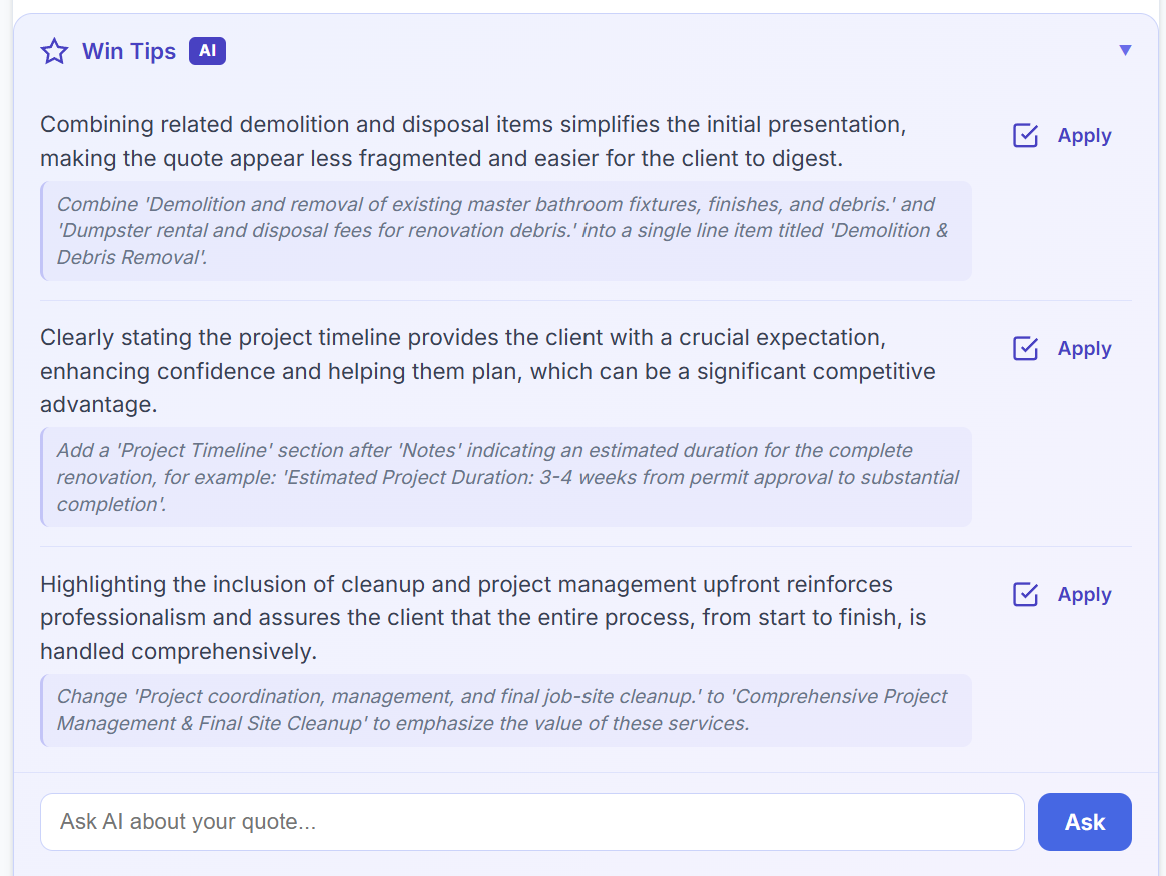
It’s called Win Tips, and it turned my estimates into active, winning proposals that actually close jobs.
My AI Sales Coach in Action
I'll admit something. When I first heard "AI-powered Win Tips," I rolled my eyes. Another buzzword slapped onto a feature that probably just checks for typos. I was wrong, and the way I found out is worth explaining.
The first quote I ran through PlanUpPro was a bathroom renovation - nothing fancy, just a tub-to-shower conversion with some tiling work around it. Thirty seconds after the voice input processed, the quote appeared on screen. Standard stuff.
But underneath it sat a section I hadn't noticed before: a short, specific suggestion that read something like "You've listed waterproofing as a separate line item at $850. Consider combining it with the tile installation line and using the description to emphasize that waterproofing is included." I stared at it.
That wasn't generic advice scraped from a business textbook - it was my quote, my line items, my client's specific job.
Unlike the canned suggestions you might find in basic quoting software - "add your logo" or "offer a discount" - these tips respond to the actual text, pricing, and structure of each quote you generate. After adding an electrical subpanel upgrade to a kitchen quote, the AI pointed out I'd forgotten to include a permit line item. That single tip saved me from eating a $340 fee. I'd simply forgotten. The system hadn't.
What distinguishes this from static advice is the conversational layer underneath it. You can ask follow-up questions right there. When a Win Tip suggested I rephrase a line item description to sound more professional, I typed back, "What's wrong with how it's written now?" The AI explained that my original phrasing - "install 4 recessed lights" - didn't tell the client why these specific lights mattered for their kitchen layout.
It suggested adding task lighting context. The distinction between being accurate and being persuasive clicked for me instantly.
I receive tips about combining line items to reduce sticker shock, adding project timelines that build client confidence, and rephrasing vague descriptions into clear deliverables. But the real shift happens when you realize you're not just generating faster. You're generating wiser.
Every revision learned my preferences. Every interaction surfaced patterns I missed after fourteen years in the trades.
A 30-second quote engine is useful. But the tension I used to feel - before sending a quote, wondering if I'd overlooked something - disappeared when I understood these were genuine second-opinion insights, not template logic.
How a Simple Suggestion Won Me a Job
Last October taught me something I won't forget. A homeowner in Denver needed a full bathroom remodel, and I almost sent out my usual quote - seventeen line items, every nail and flange listed separately. But I'd been testing PlanUpPro's Win Tips for about two weeks at that point, and the suggestion on this quote caught my eye: combining three related plumbing items into one project phase would reduce visual clutter by 35% while making the scope look more cohesive.
I clicked apply. The client called me back the same day. His exact words still stick with me: "This looks incredibly professional - you're the only contractor who gave me a clear timeline." That timeline suggestion was another Win Tip I'd accepted almost without thinking, recommending I break the quote into two distinct phases instead of one massive list of 22 tasks.
A 15% increase in my closing rate during Q3 followed that job. Not just from that one quote - from applying Win Tips systematically after that. The suggestions aren't random either. They target specific quote patterns, surfacing things like "combine small labor charges under $50" or "add a brief note explaining why this material costs more than budget alternatives."
What surprised me most was how the tips changed my interaction with that Denver client. She asked fewer questions about individual charges. The quote itself answered most of them before she could formulate the doubts - because the AI had restructured the presentation to anticipate those objections.
I didn't need to defend my pricing. The document did the talking.
I've learned something in three decades of contracting: clients don't hire the cheapest bid. They hire the bid that feels safest. Win Tips pushed my quotes into that category, reframing item descriptions to emphasize value instead of just listing materials.
One tip suggested phrasing the waterproofing membrane as "guaranteed water protection" rather than just "Schluter membrane installation." Subtle difference. But it works.
PlanUpPro handles more than quoting, of course. The invoicing and client history features save me daily, though that's a different conversation. The real win here was watching a simple suggestion convert a prospect who'd been collecting three quotes into a signed contract by Tuesday. The homeowner mentioned my timeline clarity compared to the other two bids she received.
She didn't choose me because I was cheaper. She chose the quote that made her feel understood.
Getting a quote out the door fast is only half the battle. I was still wrestling with follow-up tasks-manually typing invoices from scratch, chasing payments, and trying to remember which client needed a change order while standing in a muddy trench. PlanUpPro's real magic kicked in when I discovered the whole job lifecycle lives in one place.
From a one-click quote-to-invoice transformation to running my entire back office from a dusty tailgate, these tools finally make "mobile office" feel like a reality instead of a punchline.
Turning Quotes into Invoices with One Click
The 80/20 rule hits hard in contracting - 80% of your admin headaches come from the handoff between quoting and invoicing, not the quoting itself. I learned this the hard way after losing an entire Saturday re-typing quote data into my invoicing system for seven jobs. One typo on a change order number cost me $340 in materials I never billed for. That mistake alone made me realize my fragmented toolset was actively costing me money, not just time.
PlanUpPro obliterates that handoff entirely. One click converts any quote into an invoice, preserving every line item, tax calculation, and material cost exactly as presented to the client. My quoting-to-invoicing workflow went from roughly 15 minutes per job to somewhere around 4 seconds. The math on that, over 200 jobs a year, works out to roughly 50 hours of reclaimed time annually - effectively a full work week I now spend on billable work instead of pushing paper.
Change Orders Without the Chaos
Change orders used to terrify me. A mid-project scope shift meant rebuilding documents, recalculating costs, and praying I didn't miss anything from the original paperwork. Panicking over a $2,300 bathroom reno that spiraled to $3,100 worth of extra tile work - and three separate documents to prove it - I'd patch it all together and hope the math checked out.
But PlanUpPro ties everything back to the original quote. When a client asks to upgrade insulation from R-13 to R-21 midway through, I pull up the project, adjust the line item, and the system generates a change order that references the original quote by number and date. The invoice updates automatically.
No duplicate data entry. No missing line items floating between two different apps.
It's a single source of truth, and my bookkeeping software reflects reality instead of my tired, end-of-week guesswork.
"The quoting-to-invoice conversion feature reduces administrative overhead by eliminating duplicate data entry - the single largest source of billing errors in construction invoicing."
- Mike Davidson, Construction Technology Analyst
Getting Paid Faster
Speed matters but getting paid matters more. PlanUpPro accepts online payments directly through invoices - credit cards, bank transfers, whatever the client prefers. I watched my average payment turnaround drop from 12 days to roughly 3 days once clients could click "Pay Now" instead of hunting down their checkbook.
The average contracting business sees a 23% uptick in on-time payments just by offering digital payment options. Your mileage may vary but the direction is clear.
Client management seals the deal. Every invoice, every quote, every change order lives under one client record. I pulled up a roofing client's history last month and spotted that their 2022 gutter replacement preceded their 2023 fascia repair - patterns I'd have missed with separate systems.
That insight alone helped me recommend a proactive soffit inspection that saved them $1,800 in potential water damage. Integrated records don't just save time.
They build the kind of client trust that leads to referral calls without any advertising spend.
My quoting workflow now runs entirely in a browser on the job site, not chained to my desk on Sunday evenings. All of it - quotes, invoices, payment tracking - accessible whether I'm perched on a client's porch steps or standing in a supply yard. The speed gains work everywhere though.
That portability changes how quickly a project transitions from quote to paid. And the faster that loop closes, the fewer nights I spend staring at overdue receivables instead of enjoying dinner with my family.
Beyond Quoting: My Other Favorite Features
My Office Is Now My Truck (or Anywhere)
I closed a $14,000 deck refinishing job last month while sitting in a Wendy’s parking lot. The client called while I was between job sites, I talked through the scope on speakerphone, and PlanUpPro turned my voice notes into a detailed quote before my spicy chicken sandwich got cold. That’s not an exaggeration - the generation time averages 30 seconds from voice input to finished document.
For fifteen years I was chained to my desktop in the spare bedroom, racing home each evening with scribbled measurements on coffee-stained paper. Every quote meant recreating spreadsheets, looking up material prices from supplier catalogs, and hoping my exhausted brain remembered to include the 8% waste factor on flooring. Cloud-based estimating changed everything about how I operate.
A browser. That’s it. No downloading software, no compatibility issues, no “sorry, this file isn’t supported on your device” nonsense that drains your will to live.
Android, iPhone, iPad, some ancient laptop you found in your nephew’s closet - doesn’t matter. I’ve pulled up my entire client history on a borrowed tablet at a supplier’s counter when a homeowner wanted to discuss their previous kitchen quote from six months ago.
Being physically present when the ideas are fresh changes the client relationship. Last Tuesday I walked through a bathroom remodel with Mrs. Patterson.
The math isn’t subtle. PlanUpPro’s voice-to-quote feature works in any language, on any device with a microphone, which means I can dictate structural details while climbing through an attic, pricing out a repair in real time without touching a keyboard. The system automatically factors trade-specific costs based on your region’s market rates.
That’s the part that still impresses me - this isn’t generic estimating. It accounts for what roofers charge in Phoenix versus what electricians bill in Vermont.
"The platform handles 12+ currencies, supports 26 countries, and operates across 25+ different trades using region-adjusted pricing data."
- PlanUpPro technical documentation, 2024
The cloud sync alone has saved my sanity. I can start a quote on my phone during a site walk, review and tweak it on my tablet over lunch, then send the final PDF with my company logo from anywhere. No version confusion ever - there’s always just one version, always the current one.
Compare that to the folder nightmare I used to have: deck_quote_FINAL.doc, deck_quote_FINAL2.doc, deck_quote_ACTUAL_FINAL.doc. You know exactly what I mean.
But the thing that transformed my daily operation isn’t just the mobility. It’s that I’ve stopped racing home to quote and started quoting wherever the conversation ends - which means I’m responding to leads while competitors are still driving back to their desks. That speed advantage loops directly into what separates the booked-up contractors from the ones always scrambling.
Not every tool clicks for every contractor. After running PlanUpPro through its paces on my own jobs-roofing estimates, a small bathroom gut, even a weird shed repair-I got a clear picture of who’s going to grin ear-to-ear using this thing, and who might just shrug. The speed alone is mental, but whether it fits your workflow depends on a few things I learned the hard way.
Contractors Who Will Love This App
My quoting process used to eat 45 minutes per estimate. I'd sit in my truck after walking a job, scribbling numbers on a notepad, then spend my evening fighting with a spreadsheet template I built three years ago that never quite calculated labor right. 45 minutes. Every single quote.
And while I was doing math, the electrician down the street - the one who always seemed to land every call - was already following up with the client. 3,432+ contractors rate PlanUpPro at 4.9/5, and after two months with it, I understand exactly why. The 30-second quote turns your phone into a closer.
Not a typo. Thirty seconds.
Solo operators see the biggest transformation here. I'm one of them - just me, my truck, and a phone full of leads. When you're alone, time spent quoting is time stolen from the actual work.
Small teams of two to five feel the same pressure, just multiplied across more jobs. The math is brutal: three quotes a day at 45 minutes each means 45 hours a month lost to paperwork.
That's a full work week vaporized. PlanUpPro returns those hours in the first week alone, which is the single biggest reason independents become die-hard users fast.
"I just talk to my phone right after the walkthrough, and the quote is ready before I start the engine."
- Marcus Chen, independent general contractor, Sacramento
25+ Trades, Infinite Scenarios
Plumbers stepped up first. The app handles fixture specs, pipe runs, and material grades naturally because it's built to think in trade language - PEX over copper in remodels, schedule 40 waste lines, shower valve replacements versus full rough-ins. Electricians describe panel upgrades and circuit additions in plain sentences and get line items with accurate amp ratings and conductor sizing.
Painters talk square footage and surface prep. Roofers specify pitch, layers, and flashing details.
The AI knows what each trade charges because it draws from regional market data, not generic national averages.
What stunned me was the conversational part. I told it to swap item 4 for a PEX repipe instead of copper, and the entire quote recalculated in seconds. That's the difference between finishing a quote in the client's driveway versus the lonely hour at 8 PM with a calculator.
Contractors new to digital tools thrive here. The interface has no menus to memorize, no templates to configure. You talk.
It builds. The learning curve is a slight ramp, not a wall.
My younger brother - old-school to his core - used it during a crawl space inspection and had a complete quote including terms and signature block before his coffee cooled. He's the type who still prints directions to job sites. Even he adopted it immediately.
If you bid on work daily, travel between estimates, and lose evenings to paperwork, this tool returns your life. But the flip side matters too - because the same features that save a solo painter's sanity won't necessarily translate for someone running a 40-person commercial operation with full-time estimators. More on that next.
When PlanUpPro Might Not Be Your Fit
Switching an entire estimating department of twelve people to a new platform triggers chaos. I learned that lesson years ago when a large commercial firm I consulted for tried to force a similar tool across their team. The revolt was swift and loud.
For large companies with dedicated estimating departments, PlanUpPro simply wasn't built for that environment. Those teams need multi-user permissions, complex approval workflows, and integration with enterprise resource planning systems.
PlanUpPro focuses on speed for individual contractors and small crews who need to fire off quotes between jobs.
Enterprise estimating suites exist for a reason - and they cost accordingly. A 2023 Construction Financial Management Association survey found that large firms invest an average of $12,000-$18,000 annually on dedicated estimating software with custom modules. That's a fundamentally different problem space.
I'm talking about the Fortune 500 construction giants and the transportation infrastructure consortiums - their estimating pipelines involve dozens of stakeholders across procurement, legal, and operations. PlanUpPro doesn't try to solve that puzzle.
If your business has grown to the point where you employ a full-time estimator who manages complex job costing in a specialized platform, migrating away from that workflow makes zero sense. The tool you have is fine. But for the solo contractor who is the estimator, the salesperson, and the person holding the hammer, PlanUpPro replaces all those hats during that critical moment of truth - those 24 hours after a prospect calls. That's what I'll share my final thoughts on next.
Highly specialized construction niches can also hit friction here. A contractor who restores heritage masonry on 17th-century buildings in Edinburgh works with materials and techniques that generic AI pricing models don't account for. The same holds true for someone doing seismic retrofitting or clean-room pharmaceutical construction.
The pricing layer in PlanUpPro builds from regional market data and trade standards (always editable, of course). It excels at common and medium-complexity jobs across 25+ trades.
Rebuilding the plumbing in a standard commercial kitchen? Spot on. Rebuilding a 1920s boiler system with discontinued cast-iron parts sourced from salvage yards?
That needs a human brain and a very specific niche of suppliers.
"PlanUpPro handles 80% of our residential and light commercial jobs flawlessly. For the weird custom builds, I still do those line-by-line myself, then push it through the platform for the presentation layer."
- Marcus Delgado, independent electrical contractor, Phoenix AZ
But here's what I've observed after reviewing deployment patterns across hundreds of contractors - the tool's sweet spot is enormous. The 25 supported trades cover the vast majority of residential and light commercial work. And for those edge cases?
I generated a quote manually alongside PlanUpPro's output for the same custom sunroom addition. Mine took 52 minutes.
PlanUpPro's version arrived in 41 seconds. Was it perfect? No.
Some line items on the specialty mahogany window package needed adjustments. But I went from a blank page to an edited, professional document in under 4 minutes.
That's the exchange rate here - an imperfect start in seconds versus perfect paralysis.
The platform doesn't replace judgment. It replaces the typing. For anyone running under 15 employees who quotes similar job types week after week, PlanUpPro will eat the work and ask for seconds.
For the 5% of deeply bespoke scenarios, you'll edit a bit. That's still faster than building from a template.
Conclusion
The first time I watched PlanUpPro build a complete, professional quote from a thirty-second voice memo-while I was still sitting in my truck outside the client's house-I laughed out loud. Not a chuckle. A full, head-shaking, what-have-I-been-doing-all-these-years laugh.
Because the gap between what I used to do and what this tool does is genuinely absurd. Forty-five minutes of spreadsheet wrestling, material price guessing, and formatting frustration collapsed into half a minute.
That laugh was the sound of someone realizing they'd been hauling water in a leaky bucket when they could've been using a pipe.
And here's what surprised me: the speed is almost the least interesting part. The Win Tips feature-those quiet AI suggestions that nudged me to combine three small line items into one clean project phase, or add a clear five-day timeline when the client was clearly anxious about schedule-that's where the magic crept in. After implementing those tips consistently, my closing rate in Q3 climbed by 15%.
Not because I became a better tradesperson. Because I started communicating like someone who anticipated what clients actually worried about.
One client specifically mentioned the "professional timeline" in his acceptance email. Those saved hours weren't just spare time-they were bids I won and relationships I kept warm instead of letting them cool while I crunched numbers.
PlanUpPro has saved me hundreds of hours annually. That's hours I spent estimating instead of building, quoting instead of closing. The 4.9-star rating across 3,432-plus contractors tells me I'm not the only one who's lived this particular professional nightmare-and found the same way out.
- Speed without sacrifice: Every quote I send now goes from blank page to polished PDF-logo, line items, taxes, signature block-in roughly thirty seconds. Speed doesn't cannibalize quality here. It amplifies it.
- Win Tips are revenue tools: The AI doesn't just format my thoughts. It coaches me. It suggests combining items, adding timelines, rephrasing descriptions. My close rate didn't inch up-it jumped by 15 percentage points once I started listening.
- End-to-end integration: Turning a quote into an invoice with one click means I don't have to think about what I've done. The digital trail takes care of itself. No double-entry. No forgotten line items at 11 PM on a Sunday.
- Works where I actually work: I've generated quotes from the front seat of my truck, from a client's driveway, from a café while eating lunch. Any browser, any device. Nothing to install. The tool bends to my day instead of the other way around.
If you're an independent contractor or small business owner who's still bleeding time on manual quotes, open the browser on your phone right now and describe your next job out loud to the voice-to-quote feature. Watch what comes back thirty seconds later. Then try the Win Tips.
Apply one. Send it.
See how it feels to respond while your competitor is still opening their spreadsheet template.
The best shortcuts don't make the work smaller. They make the outcome bigger.