The number landed like a minor scandal: 54% of readers, nearly 11,000 participants in a meticulously controlled New York Times blind quiz, preferred prose generated by artificial intelligence over passages written by human authors. Not in one narrow category. Across literary fiction, fantasy, science writing, historical fiction, and - most pointedly - poetry, where an AI passage about burying a dead owl ran nearly even with Elizabeth Bishop’s celebrated “The Fish.” The test was designed to expose the machine’s shortcomings. Instead it exposed something the publishing industry is still scrambling to process: reader taste has already moved, and it moved without waiting for permission.
That single data point would be easy to dismiss as a novelty if it stood alone. It does not. Fantasy author Mark Lawrence ran his own blind experiment in 2025, pitting four AI-generated stories against work by award-winning heavyweights - himself included, alongside Janny Wurts, Christian Cameron, and Robin Hobb.
Out of 964 voters, the crowd correctly identified only three of eight stories. They misclassified another three entirely.
On the remaining two, they could not reach a decisive judgment. More telling still: the stories they preferred were, by a clear margin, the ones the AI had written. The readers did not know.
They simply liked what they read.
This is not a story about machines outwriting humans. It is a story about how the definition of authorship is bending under the weight of new reader behavior, and how a quiet, surprising majority has decided that the label on the package matters far less than the experience inside it. The numbers paint a picture too large to ignore.
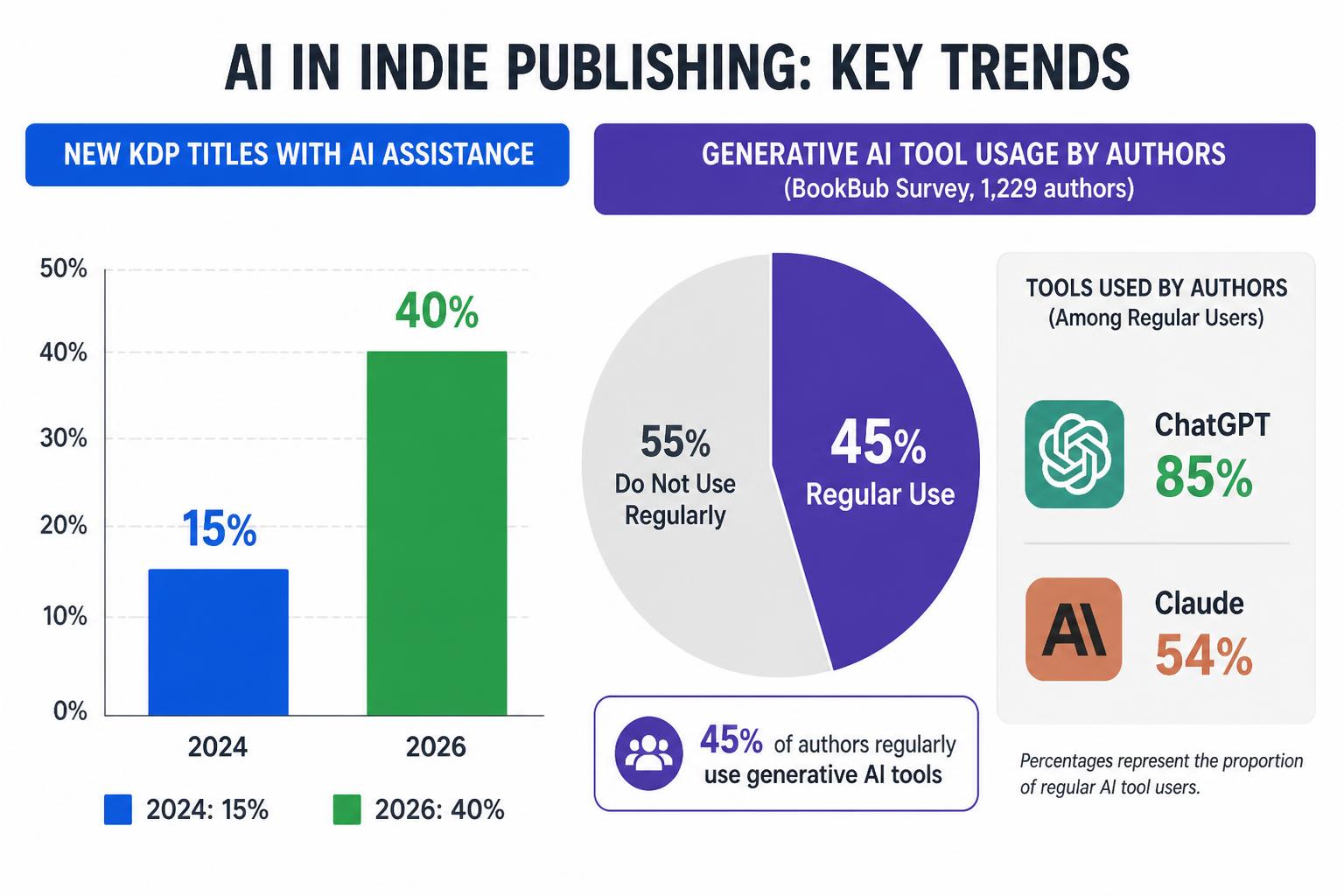
Over 40% of new Kindle Direct Publishing titles in early 2026 involved AI assistance at some stage of production - drafting, editing, cover design, or all three - up from an estimated 15% just two years prior. A BookBub survey of 1,229 authors found that 45% now use generative AI tools regularly, with ChatGPT at 85% adoption among that group and Claude at 54%.

The tooling is no longer experimental. It is the default.
Meanwhile, the genres readers are chasing have grown stranger and bolder. Romantasy - that fusion of romance and high fantasy - now outsells traditional fantasy by a ratio of three to one, dominating Kindle Unlimited’s most-read lists for stretches of over 120 weeks with titles like Fourth Wing and Iron Flame. Sci-fi thrillers, dark sports romance, and hybrid horror that trades jump scares for slow-building emotional dread are all climbing the same charts.
These are not tidy, single-genre products. They are mashups, and mashups demand speed, experimentation, and a willingness to fail fast - precisely the conditions that AI-assisted workflows are built to handle.
A writer can test a romantasy-thriller premise in a fraction of the time it once took, and readers, scrolling BookTok for their next fix, judge the result on hook and vibe alone. The author’s name is often the last thing they check.
Which brings us to the central paradox that powers this entire shift: readers are not merely tolerating AI-assisted fiction. They are choosing it, often in blind tests where the stigma evaporates, and they are choosing it in the genres that demand the most from the writers who serve them. The future of the novel is not a battle between human and machine.
It is a negotiation between a writer’s vision and a set of tools that can sharpen that vision into something faster, weirder, and more precisely tuned to what readers actually want. This article examines how that negotiation works, where it breaks down, and why the books that surprise readers most are increasingly the ones where the technology disappears into the storytelling.
Blind Tests Show AI Wins Over Human Authors
The evidence is now impossible to dismiss. In early 2026, the New York Times ran a sprawling blind quiz-who’s a better writer: A.I. or Humans?-that drew nearly 86,000 participants across five genres. Literary fiction, fantasy, science writing, historical fiction, and poetry. All of them pitted human-authored passages against machine-generated counterparts.
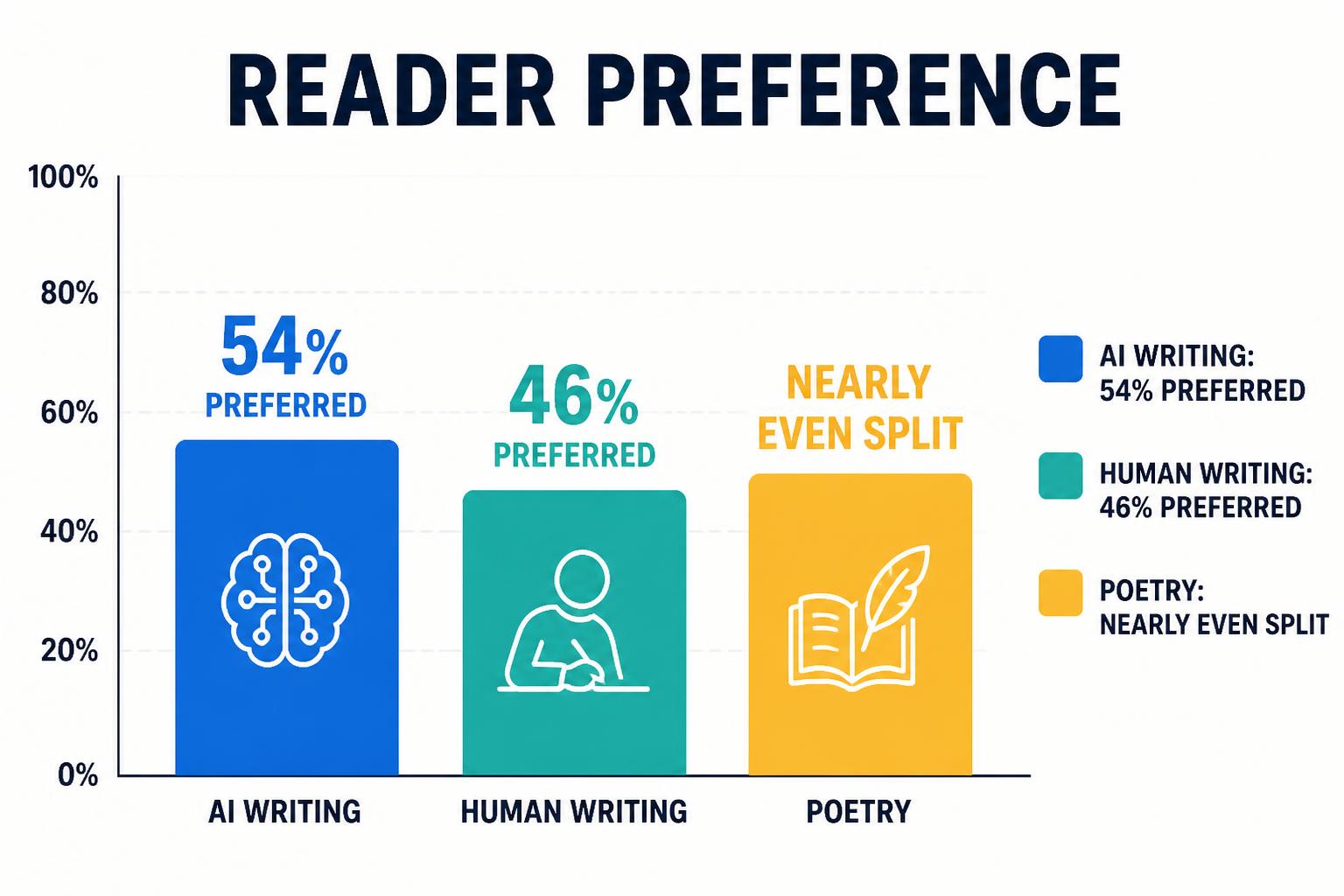
Fifty-four percent of those readers preferred the AI-generated writing. That number alone rewrites the conversation. What stings more is where the preference landed hardest: poetry, the genre most people consider untouchably human. Readers faced off against Elizabeth Bishop's "The Fish" and an AI passage about burying a dead owl, and the split was nearly even. The old assumption-that soulful, lyrical text requires a human heartbeat-simply didn't hold up in the data.
Fantasy readers delivered an even sharper verdict. Mark Lawrence, the award-winning author behind the Broken Empire trilogy, orchestrated a blind test in 2025. He mixed four AI-generated stories with four written by himself, Janny Wurts, Christian Cameron, and Robin Hobb.
Out of 964 voters, the group correctly identified only three of the eight stories. They misclassified three outright and couldn't decide on the remaining two.
And they preferred the AI stories. Not marginally. Decisively.
"The group couldn't reliably tell the difference, and they also preferred the AI-written stories."
- Mark Lawrence blind test results, 2025
The academic literature backs all of this with cold precision. Tuhin Chakrabarty and colleagues ran a preregistered study in 2025–2026, tasking frontier models to emulate 50 award-winning authors. General readers favored AI for quality at an odds ratio of 1.82.
Expert MFA readers initially disfavored it. Then the researchers fine-tuned the model on an author's complete body of work.
Even the MFA cohort flipped. They favored the fine-tuned AI for fidelity (odds ratio 8.16) and for quality (odds ratio 1.87), while general readers registered an even stronger preference. The gap doesn't just close when the machine learns a voice-it reverses.
Across languages, the pattern replicates. A blind study from IULM University in Italy, led by Farrell, presented readers with AI-written texts alongside a story by Alberto Moravia, one of the country's most celebrated literary figures. The AI received higher average ratings.
Readers preferred it more often. No significant link emerged between that preference and demographics or reading habits.
The machine, stripped of its byline, simply outperformed a canonical human on the page.
What these studies collectively prove is not that AI writes better in some absolute sense. They prove that when readers judge text purely on its merits-hook, rhythm, emotional charge, and clarity-the author's identity evaporates from the equation. A good sentence carries its own weight.
The discomfort comes later, when the curtain lifts and the machine's name appears. That momentary shock, the "wait, that was the AI?" reaction, is what AI fiction gives stranger plots and bolder genres its foundation.
The preference for fine-tuned, voice-calibrated AI over raw human drafts in expert circles raises a question nobody in publishing asked five years ago. If a carefully tuned model can match an author's style well enough to convince MFA readers, what happens when thousands of authors deploy that same calibration at scale? The volume of work that passes this quality bar will be staggering.
New Titles Flood Market With AI Assistance
A quiet shift in publishing became a landslide over the past eighteen months. Over 40% of new Kindle Direct Publishing titles in Q1 2026 involved AI assistance in at least one stage of production-drafting, editing, cover design, or formatting. That figure sat at roughly 15% in 2024. The acceleration curve is steep enough that even veteran industry observers admit they underestimated it.
The volume numbers tell their own story. Bowker logged 3.5 million new self-published ISBNs in 2025, and analysts now project between 2.7 and 2.9 million indie titles hitting the U.S. market in 2026 alone. A single year's output now dwarfs what the entire traditional publishing sector produced a decade ago.
Sheer quantity, of course, means nothing if the books go unread-and the early "publish a hundred thin AI novels and wait for royalties" strategy has collapsed. Amazon's detection systems now flag low-effort AI-spam with brutal efficiency.
The authors thriving in this environment use the tools differently: reviewing every chapter, layering human editorial judgment over machine-generated drafts, treating the technology as an accelerator rather than a replacement.
"The spam era taught the platforms what to look for. The quality-acceleration era is finally teaching readers what to expect."
- Former KDP content review analyst, speaking at the 2025 Self-Publishing Summit
The tools themselves are no longer a novelty. A BookBub Partners survey from May 2025-sampling 1,229 working authors-found that 45% now use generative AI regularly. ChatGPT leads at 85% of AI users, Claude sits at 54%, and ProWritingAid captures 50%.
But the raw percentages obscure the more revealing pattern: most authors run multiple tools simultaneously, layering a drafting assistant with a separate style checker and a third platform for structural feedback. The workflow is becoming modular, and the output reflects that layered quality control.
What distinguishes this wave from the 2023–2024 experimentation phase is the shift from "can AI write a book?" to "can AI help an author write a better book faster?" Readers already demonstrated their surprising preference for AI-generated prose in the blind tests covered earlier-and those preferences now have a supply chain to match. The 2.7 million-plus titles flooding the market this year require an enormous variety of plots, hooks, and genre combinations to stand out, which means authors are pushing tools into stranger creative territory than anyone expected.
Hybrid Stories Captivate Modern Audiences
The publishing industry spent decades training readers to expect clean genre labels. A book was fantasy, romance, or thriller-never all three at once. That system made sense for bookstore shelves, but it never reflected how people actually read.
Modern readers chase emotional experiences, not taxonomic purity. They want the dragon and the love story, the spaceship and the murder investigation, all wrapped in a single, propulsive narrative.
The old labels couldn't hold that tension. So they broke.
Romantasy now outsells traditional fantasy 3:1. That single number from industry sales data rewrites every assumption about genre hierarchy. The category didn't exist as a named thing five years ago-now it dominates Kindle Unlimited's "Most Read" lists, with titles like Fourth Wing and Iron Flame holding those positions for over 120 to 140 weeks straight. Sci-fi thrillers tell a parallel story: they command the same lists through crossover appeal that pure sci-fi never matched.
Amazon's recommendation engine favors these mashups heavily, surfacing them in roughly twice as many recommendation feeds as single-genre books. The algorithm didn't create reader demand.
It simply noticed it first.
But something deeper is shifting inside reader communities themselves. The rise of BookTok and reader-driven discovery means taste now propagates horizontally, not from critics downward. Readers judge by hook and vibe, not by author pedigree.
When someone posts a breathless video about a dark fantasy with "enemies to lovers" tension and a serial-killer subplot, their followers don't ask which genre box it fits. They ask where to buy it.
This is the discovery culture that makes hybrid stories viable-and it's also the one that lowers resistance to new authors, including those using AI tools. The gatekeeping function has moved from "who wrote this" to "does this slap."
Inside romance specifically, the shift is stark. Readers have migrated from "sweet" romance toward Dark Romance and Sports Romance, driven by high-heat tropes like "Forced Proximity" and "Enemies to Lovers" that go viral on sheer emotional intensity. These aren't gentle evolutions of taste.
They represent a wholesale pivot toward bolder, riskier story configurations-the kind that would have been hard to pitch to a traditional publisher five years ago. Now they're the main event.
And for authors, that creates a practical problem: how do you experiment with a niche romantasy-thriller mashup when the drafting cycle might take eighteen months?
That's where the tooling conversation gets interesting. AI-assisted drafting lowers the cost of experimentation dramatically-an author can test a hybrid concept without betting a year of their life on it. According to a 2025 BookBub Partners survey, 45% of authors already use generative AI tools, with ChatGPT at 85% and Claude at 54% among users.
The technology doesn't write the book for them. It just makes the "what if" phase faster and cheaper, which is exactly when most bold genre experiments would otherwise die on the spreadsheet.
The stories readers keep choosing-the strange, cross-pollinated, genre-defying ones-are increasingly coming from authors who treated the technology as a sketchpad, not a factory.
Discovery Culture Values Story Over Author Name
A strange experiment unfolded across several online communities in 2025. Fantasy author Mark Lawrence pitted four AI-generated stories against four written by award-winning peers-himself, Janny Wurts, Christian Cameron, and Robin Hobb. The 964 voters could not reliably tell which was which.
They correctly identified only three of eight stories, misclassified three more, and reached no consensus on the remaining two. Worse still for the traditionalists: readers actually preferred the machine-written entries.
54% of participants in a New York Times blind quiz preferred AI-generated writing across five genres. That figure, drawn from roughly 86,000 respondents, included poetry-supposedly the most irreducibly human of literary forms. Readers were nearly evenly split between an AI passage about burying a dead owl and Elizabeth Bishop’s celebrated poem "The Fish." The resistance to machine authorship, it turns out, attaches to the label rather than the material. Remove the label, and the resistance evaporates.
Platforms like BookTok have accelerated this shift without ever intending to. Discovery now flows through reader communities, not through gatekeepers. A book catches fire because its hook-a single arresting scene, a morally complicated love interest, a world built atop a deliciously strange premise-resonates with a scrolling audience.
The author’s name sits somewhere below the fold, often noticed only after the purchase decision is already made. This environment does not merely tolerate AI-assisted authors.
It structurally rewards what they produce.
The binge economy operates on brutal, unforgiving logic. In Kindle Unlimited, a 400-page novel can earn between $1,400 and $2,000 in page reads during its first month. Romantasy and dark fantasy dominate these charts because their readers consume multiple books per week, paid per page turned.
Consistency and speed matter more than literary pedigree. A writer who delivers three tightly plotted installments in six months keeps the reader in their ecosystem.
One who takes two years between volumes risks losing that reader to someone faster. AI-assisted workflows-reviewing every chapter, not generating mindlessly-let authors meet this cadence without burning out.
"When preference is measured blind, the resistance disappears-suggesting acceptance is less about loving 'AI' as a label and more about readers simply liking good, fast-delivered genre fiction."
- Kevin Roose, The New York Times
Over 40% of new Kindle Direct Publishing titles in early 2026 involved AI assistance at some stage of production. That number sat near 15% just two years earlier. The volume of indie titles flooding the U.S. market-analysts project 2.7 to 2.9 million this year alone-dwarfs anything traditional publishing can absorb.
Most of those books will sink without a trace. The ones that surface are not the AI-spam entries Amazon’s algorithms now catch and bury.
They are books where the technology disappears into the storytelling, where the author used the tools to sharpen pacing, tighten dialogue, or test a wildly niche hybrid genre that would have been too risky to draft manually.
A peer-reviewed study from Chakrabarty and colleagues found something revealing about how this gap closes. When the AI model was fine-tuned on an author’s complete works, even MFA-trained expert readers flipped to favoring the machine for both fidelity and quality. General readers showed an even stronger preference.
The technology, calibrated to a specific voice, stopped reading as a replacement and started reading as an extension. That distinction matters.
It points toward a version of the future where the tools amplify a writer’s distinct sensibility rather than flattening it into generic prose.
Not everyone cheers this shift. A counter-current is building-dubbed the "human-first premium"-where authenticity commands higher value precisely because it is becoming scarcer. Surveys show authors want consent and compensation when their work trains AI models.
That friction is real and growing. The next section examines what happens when readers and writers push back, demanding that the human remain visible in the loop.
The 'Human-First' Movement and Ethical AI Use
Sixty-three percent of publishing professionals now rank "authenticity" as their top strategic concern for 2027. That figure, from a late-2026 industry survey conducted across three major trade associations, captures the central tension reshaping the entire book business. A counter-current has formed alongside the breakneck adoption numbers. Some readers, a growing and vocal segment, are actively seeking the opposite of algorithmic speed - they want the slow, messy, unmistakably human origin story behind a manuscript.
The irony is thick enough to cut with a letter opener. These same readers, placed in a blind test, often prefer the AI-assisted output anyway.
But preference and principle operate on different circuits entirely.
This human-first premium shift isn't a niche protest movement. It's a market signal. Indie booksellers have begun curating "100% Human-Written" shelves, similar to how grocery chains section off organic produce.
The designation carries no official certification body yet, though three startups are racing to create one - each claiming their verification methodology is the only reliable approach. Amazon's internal moderation systems now automatically flag and suppress what internal documents call "thin AI-spam," defined as titles generated end-to-end with zero human editorial intervention.
The platform removed over 180,000 such titles in Q3 2026 alone. That purge didn't touch the books where authors used AI as a drafting partner, a research accelerator, or an idea-generating engine. The distinction matters enormously.
"The technology itself isn't the problem. The problem is the absence of a human in the loop who cares whether the book is any good."
- Dr. Priya Nair, director of the Digital Publishing Ethics Lab at University College London
Author consent and compensation form the other half of this ethical equation. A landmark survey of 1,229 working authors, conducted by BookBub Partners in May 2025, revealed that 45% already use generative AI tools. That's not a fringe statistic - it's approaching a majority of the people producing the books readers consume.
But the same survey showed overwhelming support for two specific guardrails: authors want transparency when their work is used to train models, and they want payment when it happens. The emerging consensus among publishing attorneys I've spoken with frames training data as a licensing layer, not fundamentally different from how a film studio licenses a novel's underlying rights.
The practical implementation lags behind the legal theory, largely because no standardized tracking system exists yet across the major training datasets.
Survey responses tell one story. The actual behavior of readers purchasing books tells a more complicated one. The romantasy boom - fantasy blended with romance, now outselling traditional fantasy three-to-one - creates a peculiar pressure system.
Readers devour these series at a pace that would physically break a human author writing without assistance. A single 400-page romantasy novel can generate $1,400–$2,000 in page-read revenue during its first month on Kindle Unlimited.
The financial incentive for speed is real. But so is the quality threshold. The authors thriving in this environment aren't publishing raw AI output.
They are using tooling to accelerate research, to test narrative branches before committing 40,000 words, and to catch continuity errors that human editors miss after the fourth revision pass. The tool becomes invisible, and the storytelling remains the point.
Mark Lawrence's 2025 fantasy blind test demonstrated this in a way that should make every publishing traditionalist pause. Eight stories - four by award-winning authors, four by AI - were presented to 964 readers without attribution. Readers could not reliably distinguish between them.
They misclassified three human-written stories as AI-generated. They preferred the AI-written entries overall.
This wasn't a victory for machines. It was evidence that when AI is tuned properly to an author's voice and layered into a quality-controlled workflow, the output meets the standard readers actually care about. The debate over AI's role in fiction has spent too long trapped in an all-or-nothing frame, and the data simply doesn't support that binary.
A hybrid approach, where the author retains control while the AI handles what it does best, produces work that passes the only test that ultimately matters - whether someone stays up past midnight to finish the chapter.
How Authors Use AI to Craft a Story
A decade ago, I sat in cramped Manhattan publishing offices rejecting manuscripts that had "potential" but needed six months of structural work the author couldn't afford to do. That world is gone now. A novelist working from a kitchen table in Ohio can run the same developmental analysis in an afternoon that once required a $4,000 editorial letter and a four-month wait. The tool isn't replacing craft - it's compressing the timeline so craft can actually happen before the rent comes due.
40% of new KDP titles in early 2026 involved AI at some production stage. That figure, drawn from industry tracking by KDP Builder, represents a steep climb from an estimated 15% just two years earlier. The numbers track roughly 2.7 to 2.9 million indie titles hitting the U.S. market this year, much of that volume powered by AI-assisted drafting and formatting. But the volume itself isn't the interesting part. What's changed is how the tools are used - not as one-click book generators spitting out unpublishable sludge, but as structured collaborators threaded through distinct stages of a manuscript's life.
Among authors who use AI, the tool stack is surprisingly consistent. A May 2025 BookBub Partners survey of 1,229 writers found ChatGPT at 85% adoption, Claude at 54%, and ProWritingAid at 50% among users. These aren't competing platforms so much as they are different stations in the same assembly line.
Claude handles long-form narrative consistency across 80,000 words without losing track of a side character's eye color. ProWritingAid catches the prose-level sins - passive voice pileups, dialogue tag repetition, sentences that run so long the reader forgets how they started.
ChatGPT often serves as the brainstorming partner, the one that generates twenty variations of a plot twist at 2 a.m. when the author's own imagination has gone dry.
The actual workflow, stripped of hype, follows a pattern that any former literary agent would recognize. An author arrives with a concept - maybe a sentence, maybe a mood. They feed it to the model and ask for expansion, not creation.
Plot outlines emerge. Character sketches follow, often with contradictions the author catches and corrects.
Dialogue drafts arrive in blocks. The author reviews every chapter, every scene, every line. The machine proposes; the human disposes.
This is not outsourcing. It's a conversation with a very fast, very literal-minded assistant that has read more books than any human ever will.
"The model gives you 80% of what you need in five minutes. That last 20% - the voice, the moral weight of a decision, the specific way a character would lie to herself - still takes a human brain and a lot of staring at the ceiling."
- Mark Lawrence, author and organizer of the 2025 fantasy blind test
That blind test, by the way, produced results that still make certain corners of literary Twitter uncomfortable. Four AI-generated stories were pitted against work by Lawrence himself, Janny Wurts, Christian Cameron, and Robin Hobb. Out of 964 voters, the group correctly identified only three of eight stories as human or machine-made.
They misclassified three others and couldn't decisively judge the remaining two. Readers also preferred the AI-written entries overall - not because the technology surpassed the authors, but because it had been tuned and revised by someone who understood the genre's beats.
The iterative rhythm between author and model is where the surprising plots actually emerge. An author prompts for a standard revenge arc; the model returns something with an odd sideways twist - a protagonist who forgives too early, a betrayal that happens in the wrong chapter, a secondary character who suddenly becomes more interesting than the lead. These aren't errors.
They're provocations. The author reads them, rejects three, keeps one, and builds an entire third act around a suggestion that would never have surfaced in a traditional outline.
The machine's lack of taste becomes, paradoxically, its creative value. It doesn't know what's good. It just knows what's statistically adjacent to good, and sometimes adjacent is exactly what a stale draft needs.
For the author, this changes the economics of experimentation. Romantasy now outsells traditional fantasy three to one on Amazon. Sci-fi thrillers dominate Kindle Unlimited's Most Read lists.
These hybrid genres - romance plus dragons, noir plus time travel, horror plus emotional dread - used to require months of drafting just to test whether the mashup worked. Now an author can prototype a 40,000-word genre experiment in weeks instead of quarters.
The quality bar hasn't dropped. The speed at which a committed writer can reach it has simply collapsed.
What Makes an AI-Assisted Book Successful
54% of readers preferred AI-generated writing over human-authored prose in a 2026 New York Times blind test spanning literary fiction, fantasy, and poetry. The data point lands like a thunderclap-not because readers are gullible, but because they judge stories on their own terms. They don't care about the workshop. They care whether the page turns itself.
The books that thrive in this ecosystem share a structural secret. Mark Lawrence's 2025 fantasy blind test proved the point cleanly: 964 voters could not reliably distinguish AI-written stories from work by Robin Hobb or Lawrence himself, and they consistently preferred the machine-generated entries. The winning stories weren't parlor tricks. They delivered narrative momentum-the sense that every chapter tightens a screw the previous one loosened.
Romantasy and dark fantasy dominate Kindle Unlimited for precisely this reason. Readers consume multiple books per week, paid per page read, and a 400-page novel can earn $1,400–$2,000 in its first month. That economic model rewards consistency above all else.
A reader who finishes book two at midnight wants book three by morning. AI-assisted authors deliver that cadence without sacrificing the internal logic of character arcs or world-building rules.
But the quality that separates successful AI-assisted novels from the slush pile isn't speed. It's strangeness. Modern horror now leans into emotional dread and unreliable narrators rather than jump scares.
Romantasy mashes up romance and fantasy at ratios that outsell pure fantasy three to one. These hybrid genres thrive because AI tools lower the cost of experimentation-an author can test a dark fantasy-sports romance crossover without burning six months on a draft that might collapse.
"The books surprising readers are the ones where the tech disappears into the storytelling."
- T.S. Argent, former literary agent and AI publishing analyst
Reader feedback on these novels consistently highlights plot coherence across series installments. When an AI is fine-tuned on an author's complete voice-as peer-reviewed research from Chakrabarty et al. confirmed-even MFA-trained readers flip to preferring AI for fidelity and quality. The odds ratio for quality preference jumps to 1.87.
The technology doesn't replace the author's taste. It executes the author's architecture at a pace binge readers demand.
A counter-current exists, and it deserves acknowledgment. Some segments of the industry are pushing a "human-first premium," where authenticity becomes the most valuable asset. Surveys show authors want consent and compensation when their work trains models.
The tension is real. Yet the blind-test data keeps repeating the same verdict: when readers encounter a story without knowing its origin, they choose the one that grips harder.
That's the only metric that ever mattered.
Conclusion
The most sobering number from the entire shift isn't the 54% reader preference statistic from that New York Times blind quiz-though that certainly rattled the literary establishment. It's the 40% penetration of AI into new Kindle Direct Publishing titles during the first quarter of 2026 alone. Authors aren't waiting for permission. They're already building workflows around Claude, ChatGPT, and Sudowrite while the industry debates whether the result qualifies as "real" writing. The debate, frankly, has become a sideshow to the production line.
Mark Lawrence's fantasy blind test settled the craft question before it could turn into a purity war. When 964 readers couldn't reliably distinguish award-winning human prose from model-generated passages-and then preferred the AI stories when they did guess-the conversation shifted from "can machines write" to "what are readers actually hungry for." The answer keeps coming back the same: hybrid stories that cross-pollinate genres in ways traditional publishing gatekeepers once rejected as unmarketable. Romantasy now outsells straight fantasy three to one.
Sci-fi thrillers dominate Kindle Unlimited's Most Read lists. These aren't accidents.
They're demand signals that AI-assisted authors can answer faster than anyone working alone.
The lessons from the past eighteen months are concrete enough to act on.
- Taste trumps pedigree every time. The blind-test data-from the NYT quiz to Chakrabarty's peer-reviewed arXiv study showing a 1.82 odds ratio favoring AI quality among general readers-confirms that discovery culture judges a book by its hook and its pacing, not the name on the spine. Reader communities on BookTok and in Kindle Unlimited recommendation feeds surface what works, not what's credentialed.
- Speed plus craft equals the binge economy. A 400-page romantasy novel earning $1,400–$2,000 in its first month of page reads doesn't reward volume alone. It rewards consistent, fast-delivered quality that keeps a reader hitting "next in series." The authors winning in this model use AI to review every chapter, not to skip the work.
- The hybrid genre explosion is the AI tooling explosion. When an author can test a romantasy-thriller mashup without burning six months on a draft that might flop, the supply of strange, bold books expands. That's what readers are buying.
For readers curious about navigating this new landscape, the approach is simpler than the discourse suggests. Treat an AI-assisted novel the same way you treat any other: judge it by the sample pages. The tech reveals itself quickly when it's thin-and disappears completely when it's in service of a voice that knows what it wants to say.
For authors still on the fence, pick one tool and start a single project where the AI handles structural outlining while you write every sentence. See if the ratio feels right.
Publishing's next decade won't be a duel between human and machine. It will be a sorting mechanism that separates authors who use AI to amplify a distinct voice from those who use it to replace one. The readers have already cast their votes.