Most "AI writing tools" are not built to write a novel. They are built to help a working writer push through a paragraph, brainstorm a scene, or fix a sentence. That is useful if you already write every day. It is close to useless if what you actually want is a finished book: 60,000 to 90,000 words, a real plot, characters who stay consistent, a cover that looks like it belongs on Amazon, and a file you can upload to Kindle Direct Publishing tonight.
This guide ranks the best AI novel writers for people in the second group. Not professional authors with a five-year craft habit. People with a story idea, limited time, and a very specific goal: turn the idea into a complete, publishable novel without spending a year learning story structure first.
We looked at five platforms that come up again and again when writers search for an AI novel generator: BookNova, Sudowrite, NovelCrafter, Type.ai, and Squibler. Below is what each one is genuinely good at, where each one gets in your way, and which one we would hand to a first-time author who wants a book by the weekend.
How We Ranked These AI Novel Writers
Ranking AI writing software by feature count is meaningless. A tool with forty features and no finished books is worse than a tool with six features that gets you to a published title. So we ranked on the things that decide whether a book actually exists at the end:
- Can it write a whole novel? Not a chapter. Not an outline. A complete manuscript with a beginning, middle, and end.
- Does the prose read like a human wrote it? Repetitive phrasing, em-dash spam, and "her heart hammered against her ribs" in every chapter are the reason readers bounce off AI books on page two.
- Does chapter 14 remember chapter 3? Continuity is where nearly every AI novel tool collapses. Eye colors change. Subplots vanish. Dead characters come back for no reason.
- How much do you have to know before you start? Some tools assume you already understand beat sheets, story bibles, and prompt engineering. Beginners stall out.
- Does it get you to publish-ready? Cover, formatting, EPUB and DOCX export, KDP compatibility. A raw text file is not a book.
- What does it really cost? Subscriptions plus API keys plus a cover designer plus a formatting tool adds up fast.
Quick Comparison: Best AI Novel Writing Software in 2026
| Tool | Best For | Writes a Full Novel? | Cover Included? |
|---|---|---|---|
| BookNova | Idea to KDP-ready book, start to finish | Yes, end to end | Yes, full wraparound |
| Sudowrite | Line-level help for writers who draft themselves | Partially, with heavy input | No |
| NovelCrafter | Power users who want to build their own pipeline | Yes, if you configure it | No |
| Type.ai | Clean drafting environment, mixed content | Not really | No |
| Squibler | Fast first drafts and screenwriting | Short-form yes, novel-length is rough | Basic |
1. BookNova: The Best AI Novel Writer Overall
BookNova is the only tool on this list that treats the finished, publishable book as the product. Everything else on this list treats the manuscript as the product and leaves the rest to you. That difference sounds small until you have a 78,000-word text file, no cover, no EPUB, and no idea what KDP wants from you.
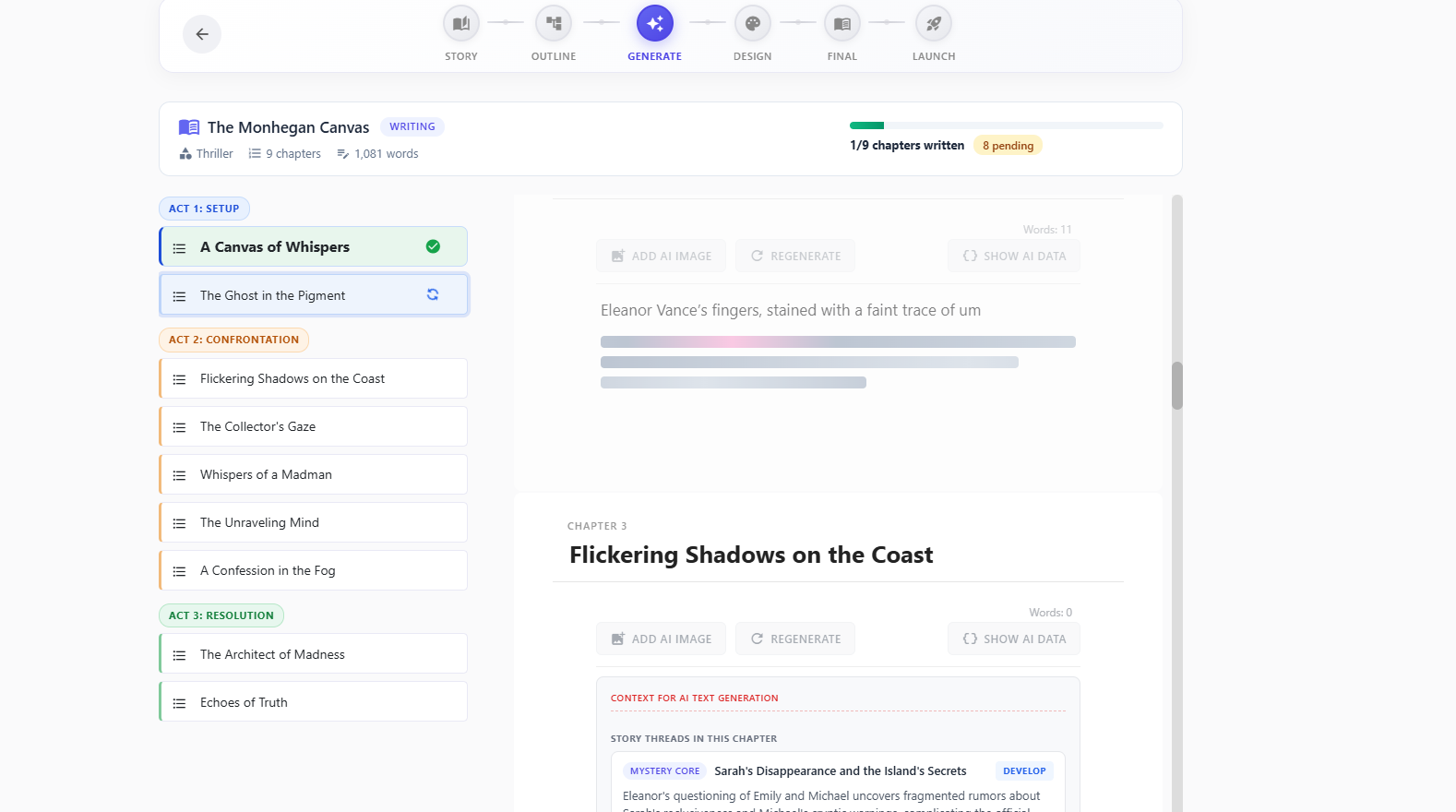
You pick a genre, drop in a premise, define your main characters, choose a tone and a point of view, and BookNova writes the book. Plot beats, scenes, dialogue, character arcs, chapter by chapter, all the way to the last page. A standard romance or thriller takes roughly an hour. An epic fantasy with heavy worldbuilding takes closer to ninety minutes. Then it generates a genre-accurate cover, chapter illustrations, and exports to PDF, EPUB, and DOCX with no branding on any of it.
Why the Prose Holds Up
The complaint that kills most AI novels is not "the plot was bad." It is "I could tell a machine wrote this." BookNova's Voice Engine is built specifically against that. It carries a curated list of AI fingerprints per language and per genre and names them before the model writes a word: the body clichés, the theatrical dialogue where characters say each other's names in every reply, the stacked atmospheric adjectives, the genitive metaphor ("her silence was an ocean of grief"), the little moral summary at the end of every chapter.
It also caps em-dashes at the rate real bestselling authors use them, roughly one per 300 words, and enforces it after generation rather than politely asking the model to behave. Each finished chapter is analyzed for overused patterns, and whatever the model leaned on in chapter 2 becomes an explicit avoid rule for chapter 3. The practical result is prose that beta readers do not immediately flag as AI. That is not a small claim, and it is the single biggest reason BookNova sits at the top of this list.
Why the Continuity Holds Up
The Story Thread Engine tracks every subplot, character, and revelation across the entire manuscript, not just the last few pages. Foreshadowing planted in chapter 3 pays off in chapter 15. Characters keep their voice, their knowledge, and their relationships. A separate Plot-Twist Audit pass scans the finished book for twists that leaked early, so your thriller does not accidentally name the killer in chapter four.
On top of that, the Chapter Craft Engine rotates eight opening techniques and eight ending techniques so you never get five chapters in a row that start with "the next morning." Each new chapter sees the actual closing paragraphs of the previous one, not just a summary, so the seams between chapters read like a novelist wrote them in order. Chapter-to-chapter flow is where cheap AI books fall apart, and it is where BookNova is furthest ahead.
Standout Features
- Genuinely excellent cover quality. Genre-accurate, bestseller-style covers plus full wraparound paperback files. Moody dark romance, epic fantasy, sleek thriller: readers know what they are holding before they read a word.
- Excellent prose quality. Voice Engine strips the AI tells that make machine-written fiction obvious, in every supported language and genre.
- Strong chapter-to-chapter continuity. The Story Thread Engine keeps names, facts, arcs, and subplots consistent from page one to the last page.
- Practically no AI tells. Banned phrase profiles, em-dash caps, and per-chapter pattern analysis run automatically on every book.
- Complete novel in 30 to 90 minutes. Not an outline. Not a chapter. The whole draft.
- Ten point-of-view formats, including the first person present dual POV that dominates BookTok romance and the third person past multi POV used by epic fantasy.
- Series support. World, cast, canon, and even character states (alive, deceased, departed, divorced) carry forward into book two automatically.
- Sail Mode. If you want to steer, you can write one chapter at a time, approving the direction, cast, location, pace, and length before each chapter is generated.
- Author Launch Kit. Character cards, aesthetic quote graphics, and teaser texts pulled from your actual book, sized for TikTok, Instagram, and Pinterest.
- KDP-ready export. PDF, EPUB, and DOCX with drop caps, scene breaks, and correct margins. No BookNova branding anywhere.
- All AI models included. No API keys to buy, no separate image generation bill, no add-ons.
- One-time payment. Lifetime plans with credits that refresh every month, instead of a subscription that charges you whether you write or not.
- 50+ languages with native genre conventions, not machine translation of English output.
- 100% publishing rights and a 30-day money-back guarantee.
Where BookNova Falls Short
Two real limitations, stated plainly, because you should know them before you buy:
- No bring-your-own-key (BYOK). Models and image generation are included in the plan and metered as credits, so you cannot plug in your own OpenAI or Anthropic key and pay raw API rates. For most authors this is a benefit, since there is nothing to configure and no surprise bill. But if you plan to generate millions of words per month, BYOK pricing could theoretically be cheaper. The mitigation is that credits refresh monthly on every lifetime plan and one-time top-up packs are available whenever you need more, so high-volume authors are not blocked, they just buy credits instead of tokens.
- No manuscript import. You cannot upload a half-finished novel and have BookNova complete it. Books are generated from scratch inside the platform, which is exactly what makes the continuity engine reliable, but it means a 30,000-word draft sitting in your Google Docs cannot be finished here. If that is your situation, NovelCrafter or Sudowrite is the better fit and we would rather tell you now than take your money.
Who BookNova Is For
You have an idea and you want a book. You do not want to learn Save the Cat, configure a prompt pipeline, hire a cover designer, or wrestle with Vellum at midnight. You want to type a premise, come back in an hour, pick a cover, and upload to KDP. If that is you, this is the tool, and nothing else on this list is close.
Write Your Novel With BookNova
2. Sudowrite: Best for Writers Who Draft Their Own Prose
Sudowrite is the best-known AI writing tool among working fiction authors, and it earned that reputation honestly. It is designed as a co-writer, not a ghostwriter. You write, it extends, rephrases, brainstorms, and describes. Features like Write, Rewrite, and the descriptive expansion tools are excellent for the specific moment when you know what happens next but cannot find the sentence.
What Sudowrite Does Well
- Strong line-level and paragraph-level suggestions that stay in your voice
- Story Bible for characters, outline, and world details
- Excellent for breaking through writer's block mid-scene
- A large, active community of published indie authors sharing workflows
- Genuinely pleasant editor to work in
Where It Falls Short for Beginners
Sudowrite assumes you are a writer. To get a full novel out of it you need to keep feeding it, chapter by chapter, making craft decisions the entire way. It does not produce covers, it does not produce KDP-ready formatted files, and it is a monthly subscription that keeps charging during the months you do not write. If you have never structured a novel before, the blank space between the features is where you will stall.
3. NovelCrafter: Best for Power Users Who Want Control
NovelCrafter is the tinkerer's choice. It gives you a codex for worldbuilding, a scene-based manuscript view, and a configurable, stage-by-stage generation pipeline where you decide which model handles which step. It supports bring-your-own-key, so you connect your own model provider and pay API rates directly.
What NovelCrafter Does Well
- Deep codex system for characters, locations, lore, and relationships
- BYOK support with granular control over which model runs each stage
- Import existing manuscripts and keep working on them
- Scene-level organization that suits long, complex books
- Low platform cost if you are comfortable managing API spend
Where It Falls Short for Beginners
The control is the cost. You are assembling the machine that writes your book, and the quality of the output depends almost entirely on how well you configure prompts, codex entries, and model selection. There is a real learning curve. No covers, no formatting, no launch assets. Two authors using NovelCrafter can get wildly different results from the same idea, and if you are new, you will spend your first month learning the tool rather than finishing a story.
4. Type.ai: Best Minimal Writing Environment
Type.ai is a clean, document-first AI editor. It feels closer to a modern word processor with a smart assistant attached than to a dedicated novel platform. If you write mixed content, some fiction, some essays, some client work, and you want one calm place to do it, Type.ai is pleasant.
What Type.ai Does Well
- Fast, distraction-free editing surface
- Solid inline AI commands for expanding, tightening, and rewriting
- Works across fiction and non-fiction without feeling bolted together
- Low friction to start writing on day one
Where It Falls Short for Novelists
There is no serious long-form continuity system. Nothing tracks your subplots across forty chapters or notices that a character's brother changed names. It is a writing environment, not a novel engine, and it produces no covers, no genre structure, and no publish-ready export. Fine as a drafting space. Not a path to a finished novel if you are starting from an idea alone.
5. Squibler: Best for Fast, Rough First Drafts
Squibler markets itself hard on speed and covers a lot of formats: novels, screenplays, short stories, non-fiction. It will generate an outline and push out chapter text quickly, and the project organization tools are reasonable for keeping a messy draft in order.
What Squibler Does Well
- Very quick outline and draft generation
- Handles screenplays and short-form alongside fiction
- Simple project and chapter organization
- Version history and collaborative editing
Where It Falls Short
Quality drops noticeably at novel length. Continuity across a full manuscript is weak, the prose carries visible AI patterns, and cover output is basic compared with what you need to compete on a KDP category page. It is a decent way to get words on a page fast. It is not a way to get a book readers will finish.
Which AI Novel Writer Should You Choose?
Match the tool to what you actually want, not to which one has the longest feature list.
- You want a finished, publishable novel and you are not a professional writer: BookNova. It is the only option here that takes you from a one-sentence idea to a cover, an EPUB, and a KDP upload in a single afternoon.
- You already draft daily and want a smarter co-writer: Sudowrite.
- You want to build and tune your own generation pipeline, or finish an existing manuscript: NovelCrafter.
- You want a calm editor with AI attached for mixed writing: Type.ai.
- You want rough words fast and you plan to rewrite heavily: Squibler.
Frequently Asked Questions About AI Novel Writers
Can AI really write a whole novel?
Yes, but only a few tools are architected for it. Writing 80,000 coherent words is a continuity problem, not a text generation problem. Any model can write a good page. Keeping chapter 41 consistent with chapter 3 requires a system that tracks state across the entire book. That is why general-purpose chatbots produce mush at novel length and why purpose-built platforms like BookNova do not.
Can I publish an AI-written novel on Amazon KDP?
Yes. Amazon KDP allows AI-generated content and asks you to disclose it during upload. You keep your publishing rights and your royalties. Disclosure is a checkbox, not a penalty, and it does not affect your listing or your ranking.
Will readers be able to tell my book was written with AI?
That depends entirely on the tool. The tells are consistent and learnable: em-dashes everywhere, the same five body clichés, characters saying each other's names in every line of dialogue, a moral summary closing every chapter. Platforms that actively strip those patterns produce prose readers do not flag. Platforms that just prompt a model to "write good fiction" produce prose readers spot in a paragraph.
How long does it take to write a novel with AI?
With a full-generation platform, 30 to 90 minutes for the draft, depending on length and genre complexity. With a co-writing tool, expect weeks to months, because you are still doing the writing. Add time either way for reading, editing, and formatting before you publish.
Do I own the copyright to an AI-generated novel?
Ownership and royalties on reputable platforms sit with you. BookNova, for example, makes no authorship claim and grants 100% publishing rights, so you can sell the book anywhere and keep every sale. Copyright law around AI-assisted work is still developing in different countries, so if you are building a large catalog it is worth reading your local guidance.
Is a one-time payment better than a subscription for AI writing software?
For most authors, yes. Fiction writing is bursty. You write three books in two months and then nothing for a season. Subscriptions charge through the quiet months. A one-time lifetime plan with monthly credit refresh matches how authors actually work, and it removes the pressure to cancel every time you take a break.
The Verdict
Sudowrite, NovelCrafter, Type.ai, and Squibler are all reasonable tools with real strengths, and if you are already an experienced writer with a drafting habit, any of them can slot into your process. But none of them was designed for the person who simply wants to hold their own novel.
BookNova wins this list because it is the only platform that owns the entire distance between an idea and a published book: the plot, the prose that does not read like a machine, the continuity that holds across forty chapters, the cover that looks like it belongs in the category, and the export file KDP accepts. It is honest about the two things it does not do, BYOK and manuscript import, and it is unmatched at everything in between. If your goal is a finished novel rather than a writing habit, start there.